
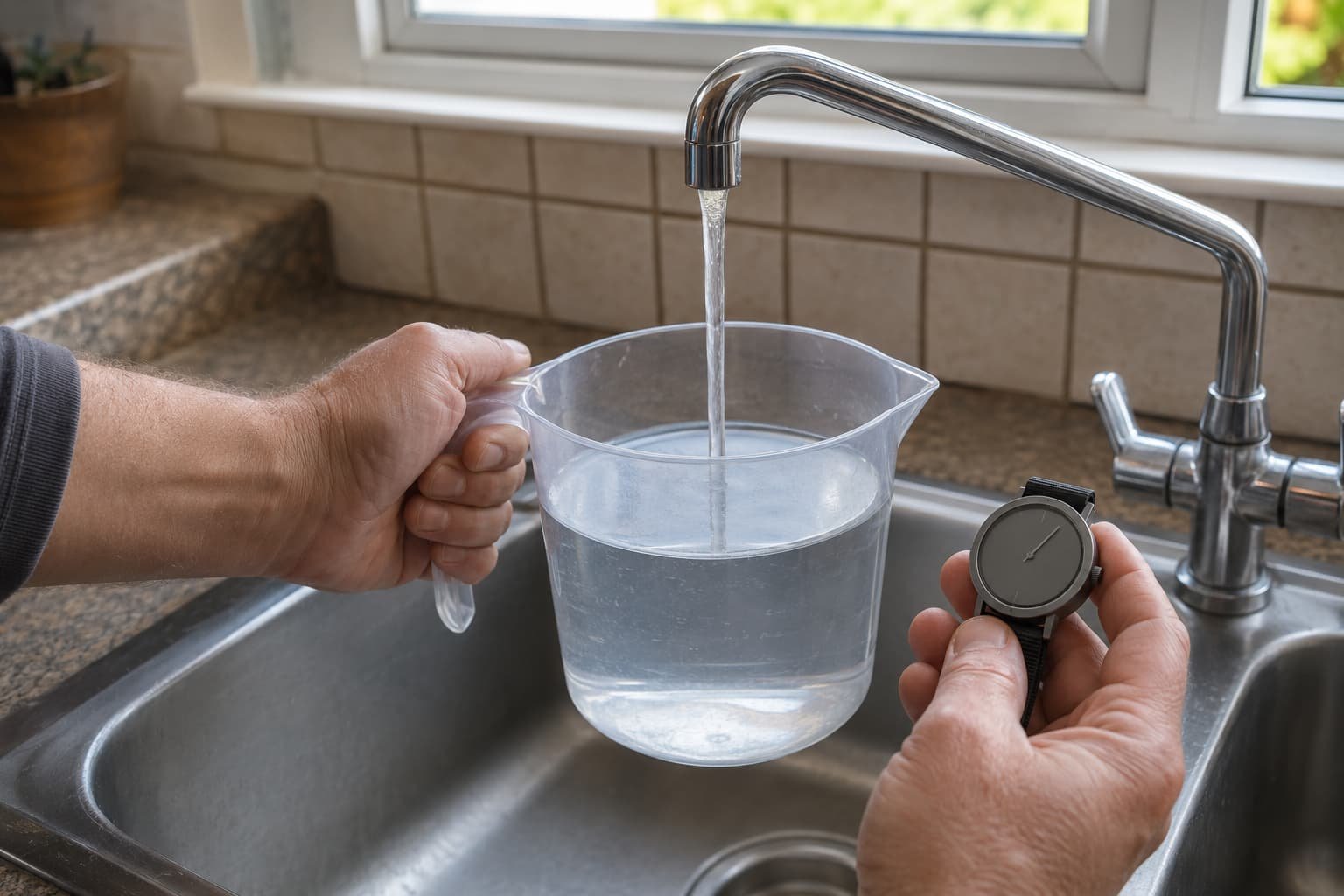
Boiler flow rate is the number that decides whether a combi boiler will delight you or disappoint you, and almost nobody is told about it before they buy one. It has nothing to do with the boiler’s brand and very little to do with its price. It is simply how much water your incoming cold main can deliver, measured in litres per minute, and you can find yours in about two minutes with a jug and a watch.
What Boiler Flow Rate Actually Means
Two different measurements get confused constantly, so it is worth separating them.
Pressure is the force behind the water, measured in bar. Flow rate is the volume arriving, measured in litres per minute. You can have decent pressure and poor flow if the supply pipe is narrow or partly blocked — the water arrives with force, but there is not much of it. For a combi boiler, flow rate is what matters, because a combi has no stored hot water. It heats what passes through it, on demand, and it cannot conjure more water than the main supplies.
A boiler’s advertised hot water output assumes a healthy incoming supply. A thirty-five kilowatt combi rated at fourteen litres a minute of hot water will not deliver that if your main only gives ten. The boiler is not underperforming. It is doing arithmetic.
The Two Minute Test
Do this yourself before you talk to any installer.
Take a measuring jug of a known size, ideally one or two litres. Go to the kitchen cold tap, because that is usually the closest outlet to where the main enters the house and gives the truest reading. Make sure nothing else is running — no washing machine, no shower, no dishwasher. Open the tap fully. Time how many seconds it takes to fill the jug exactly.
Then do the sum. If a one litre jug fills in six seconds, that is ten litres a minute. Four seconds is fifteen litres a minute. Three seconds is twenty. If you used a two litre jug, double the result.
Run it two or three times and take the average. Test at a normal time of day rather than at 6am, because mains supply can dip when the whole street is showering.
What Your Boiler Flow Rate Number Means
Under ten litres a minute is poor. A combi will struggle here and you will notice it every time someone runs a tap while you are in the shower. Either upgrade the supply or fit a system boiler with a cylinder instead.
Ten to fourteen is workable for a single bathroom household with modest demand, but two outlets at once will be uncomfortable and a bath will take a while to fill.
Fifteen to twenty is good. A well-sized combi will perform properly and a single bathroom will never feel short.
Above twenty is excellent, and you have the flow to run a large combi or to consider higher demand fittings such as a rainfall shower head, which will happily swallow twelve litres a minute on its own.
What This Looks Like Across Milton Keynes
The city divides fairly predictably, and knowing which half you are in saves a wasted conversation.
The newer estates — Brooklands, Oakgrove, Tattenhoe, Whitehouse, Fairfields and the rest of the recent development — generally have modern plastic supply pipe of a decent diameter, and flow rates tend to be comfortably in the good range. Combis suit these properties well.
The older stock is where the surprises are. Properties around Fenny Stratford, the pre-new-town streets in Bletchley, the Victorian terraces in Wolverton and New Bradwell, and parts of Newport Pagnell and Stony Stratford can still be fed by narrow or partly original supply pipe running in from the street. Those houses can show a perfectly reasonable pressure and a disappointing flow, and no boiler on the market fixes that.
If your reading is poor, the fault is usually the private supply pipe between the boundary stopcock and the house rather than the water company’s main. Replacing that run in modern MDPE typically costs six hundred to twelve hundred pounds depending on length and ground conditions, and it often transforms the reading. That is frequently cheaper than the difference between fitting a combi and fitting a full cylinder system, which makes it worth pricing before you rule a combi out.
Hard Water Makes This Worse Over Time
There is a second reason to know your baseline number, and it is specific to this area.
Milton Keynes water comes from a chalk aquifer and runs at roughly 316 to 320 milligrams per litre of calcium carbonate, which is very hard. A combi produces hot water by passing mains water through a plate heat exchanger with narrow internal channels, and in water this hard those channels scale up progressively. The hot water flow you get on the day of installation is the best it will ever be unless the water is treated.
Two practical consequences follow. Fit a scale reducer on the incoming main at installation — most manufacturers now expect it in hard water areas as a warranty condition. And write down your flow rate on the day the boiler goes in, because if you repeat the test in three years and the number has fallen noticeably, you have found scaling before it becomes a failed exchanger.
Frequently Asked Questions
Will a bigger boiler fix a low flow rate? No. Output rating and incoming flow are separate things, and the smaller of the two always wins. A bigger boiler on a weak main simply costs more to buy.
Does a water softener help? A softener addresses hardness, not flow, and some models restrict flow slightly. For protecting a boiler specifically, a scale reducer on the main is the targeted answer.
Can I test at the bathroom tap instead? You can, but the kitchen cold tap is the more reliable reading because it is usually nearest the incoming main and unrestricted.
My pressure is fine but my shower is weak. Why? That is the classic sign of good pressure and poor flow, and it usually points at the supply pipe diameter rather than the boiler or the shower.
What if I have a cylinder rather than a combi? Flow rate matters less for stored hot water systems, which is exactly why a system boiler with an unvented cylinder is the standard answer for a property with a weak main and several bathrooms.
Get Your Boiler Flow Rate Checked Properly
We measure boiler flow rate at every survey before recommending anything, and we will tell you honestly if a combi is the wrong system for your property. Read combi boiler installation for how sizing follows from the number, boiler installation for the wider process, or boiler replacement if you are changing an older system. We also handle boiler repair and annual boiler servicing.
The Heating and Hotwater Industry Council publishes independent consumer guidance on domestic heating and hot water at hhic.org.uk.
Run the test, note the number, and call 01908 870027. We can tell you a great deal about what will work in your house from that one figure.